
Photocatalytic oxidation, or PCO, is a technology with roots in both atmospheric chemistry and industrial pollution control. In the past two decades it has been miniaturised and refined for use in residential and commercial air purification products. Understanding how it works helps explain both its genuine strengths and its real-world limitations.
The basic chemistry
Photocatalysis occurs when a photocatalyst, most commonly titanium dioxide (TiO2), is illuminated by ultraviolet light. The energy from the UV photons causes electrons in the titanium dioxide to jump to a higher energy state, creating electron-hole pairs. These highly reactive species interact with water vapour and oxygen in the surrounding air to produce hydroxyl radicals (OH) and superoxide ions.
The process uses reactions at an illuminated catalyst. Actual performance depends on the equipment, contact conditions and pollutants being tested; a description of the chemistry is not evidence of a guaranteed whole-room result.
What to ask about performance
- Which product and configuration were tested?
- What contaminant and concentration were used?
- How long did the test run?
- Were any by-products or emissions measured?
- How does the intended room differ from the test environment?
Important limitations and safety considerations
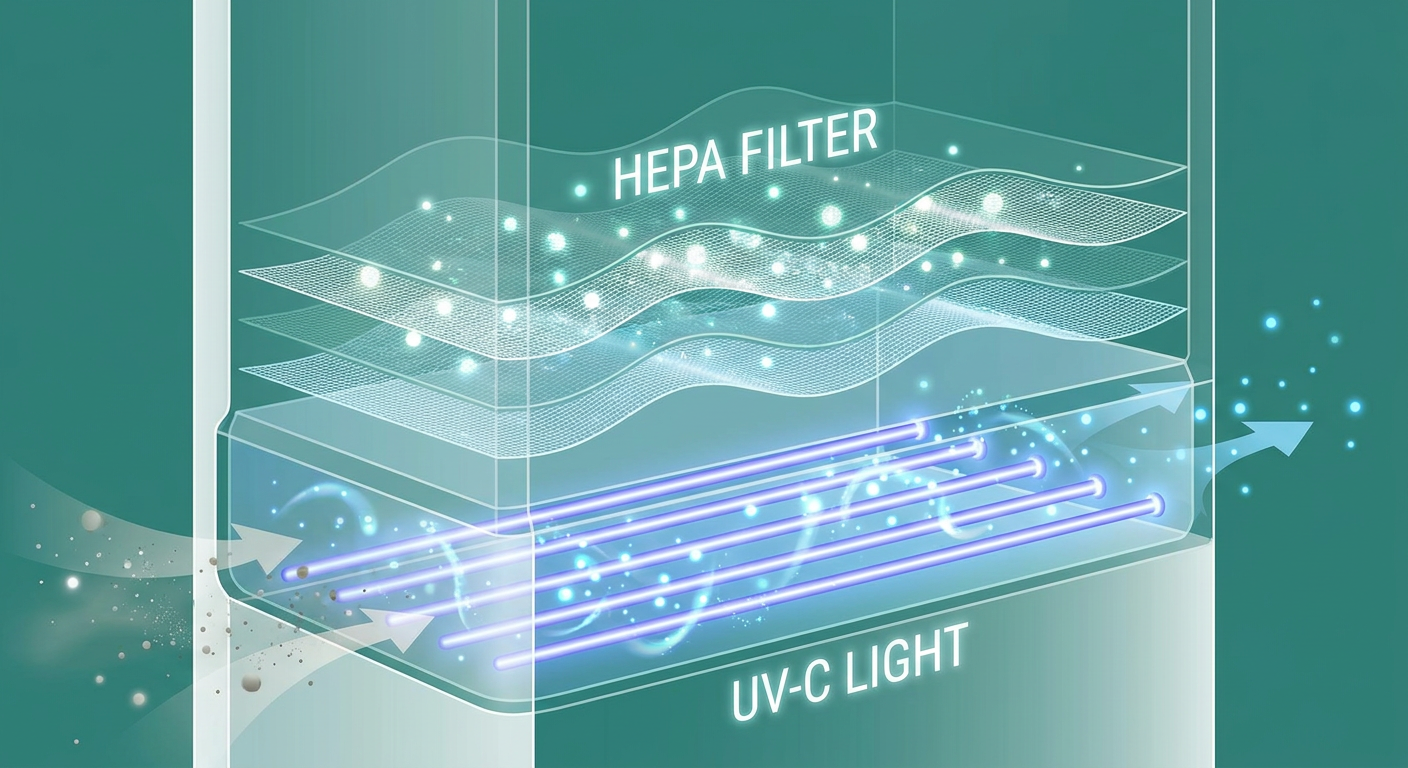
PCO and particle filtration perform different tasks. A test of chemical removal should not be taken as evidence of HEPA particle filtration, or vice versa.
Incomplete oxidation can create unwanted by-products. Do not assume that a newer generation or a product description resolves this question; ask for relevant emissions and performance evidence.
Review the full technology combination, including UV, ionisation and any intentional ozone generation. Operating restrictions and emissions information are specific to the model.
The case for combining technologies
Some products combine several technologies. That makes it especially important to understand each component, its maintenance and intended use. Additional stages alone do not establish better performance in your room.